You can make real changes to your cholesterol in 30 days, but the plan matters more than the pace. LDL starts to respond within weeks, and a month of consistent changes builds habits that carry you to a blood test at the 3-month mark. This plan adds one change a week so it feels doable, based on the foods with the best evidence.
The short version
Week 1: cut the main sources of saturated fat. Week 2: add soluble fibre (oats, beans, lentils). Week 3: add nuts, plant protein and fish. Week 4: lock in, track and move. Expect: a fall in LDL of about 5 to 15% for most people who follow it, and more with the full Portfolio Diet. Re-test: after about 3 months, not 30 days.
Before you start
- Get a baseline. If you have a recent lipid panel, note your total cholesterol, LDL, HDL, non-HDL and triglycerides. See how to read your results.
- Set your saturated fat target. The AHA aims for under 6% of calories, about 13 g on 2,000 calories; the NHS gives 30 g for men and 20 g for women. Use the saturated fat calculator.
- Check with your doctor if you take cholesterol medication, have a heart condition or have very high cholesterol (above 7.5 mmol/L or 290 mg/dL). Diet is for everyone, but some people also need treatment.
Week 1: cut the main sources of saturated fat
Saturated fat is the biggest dietary driver of LDL, so start here. Don't try to cut everything: find the two or three biggest sources in your week (use a food tracker for a few days to see them).
- Swap butter, lard and ghee for olive or rapeseed oil in cooking. A tablespoon of butter has about 7 g of saturated fat; olive oil about 2 g.
- Choose lean meat and trim the fat. Chicken breast, turkey and fish instead of sausages, bacon and fatty cuts.
- Switch full-fat dairy to semi-skimmed or skimmed milk and lower-fat yoghurt, and have cheese in small amounts.
- Limit pastries, biscuits, cakes and takeaways made with butter, cream, palm or coconut oil.
See 100 food swaps that lower cholesterol for the list.
Week 2: add soluble fibre
Soluble fibre binds cholesterol in the gut. A meta-analysis of 67 trials found about 0.06 mmol/L (2 mg/dL) of LDL lowering for each extra gram of soluble fibre a day, so 5 to 10 g makes a noticeable difference. The FDA recognises 3 g a day of oat beta-glucan as helping reduce heart disease risk.
| Food | Serving | Saturated fat | Cholesterol | kcal |
|---|---|---|---|---|
| Oats, rolled, dry | 40 g (½ cup) | 0.4 g | 0 mg | 152 |
| Black beans, boiled | ½ cup (86 g) | 0.1 g | 0 mg | 114 |
| Lentils, boiled | ½ cup (99 g) | 0.1 g | 0 mg | 115 |
| Almonds | 1 oz (28 g) | 1.1 g | 0 mg | 162 |
(The fibre column in USDA data counts total fibre, not soluble fibre.) Easy ways to add it: porridge or overnight oats for breakfast, beans on toast or in a salad at lunch, lentils in a soup or bolognese at dinner. See soluble fibre and cholesterol.
Week 3: nuts, plant protein and fish
- A handful of nuts a day (about 30 g) lowers LDL by roughly 0.12 mmol/L (4.8 mg/dL), according to the 2026 ACC/AHA guideline. Eat them instead of a less healthy snack, not on top.
- Plant protein instead of some meat (tofu, beans, lentils, soya) lowers LDL by roughly 0.20 mmol/L (7.7 mg/dL) in the same guideline.
- Fish twice a week, one of them oily (salmon, sardines, mackerel), in place of red or processed meat.
This is the Portfolio Diet approach. See the full guide; in trials it lowered LDL by about 13 to 17%.
Week 4: lock it in
- Move 150 minutes a week. Brisk walking counts. It helps your weight, triglycerides and HDL. See exercise and HDL.
- Keep alcohol to 14 units a week or less, and have alcohol-free days.
- Plan five go-to meals that fit all four weeks, so busy days don't undo it.
- Track for a week in Heart Tracker to see your average saturated fat and fibre. It shows what is working.
What to expect
| Timeframe | What typically happens |
|---|---|
| Weeks 1 to 4 | LDL begins to fall. In one fully controlled trial where all food was provided, LDL dropped 29% in 4 weeks, but real-life results are smaller. |
| Weeks 4 to 12 | Changes settle. Many people see 5 to 15% falls in LDL from diet alone. |
| About 3 months | A re-test reflects your usual diet. This is the sensible time for a blood test. |
People respond differently. Genetics, starting levels and how closely you follow the plan all matter. If your numbers don't move, or you have a very high starting level or a family history of early heart disease, talk to your doctor: you may need treatment alongside diet. See how long it takes to lower cholesterol with diet.
This is general information, not medical advice. If you take cholesterol medication or have a heart condition, check changes to your diet with your doctor, dietitian or pharmacist.
Sources
- Blumenthal RS, Morris PB, et al. 2026 ACC/AHA Guideline on the Management of Dyslipidemia. J Am Coll Cardiol. 2026;87(19). Sections 4.1.2–4.1.3.
- American Heart Association: Saturated fat (aim for under 6% of calories, about 13 g on 2,000 calories).
- NHS: Fat, the facts (saturates: up to 30 g a day for men, 20 g for women).
- Brown L, et al. Cholesterol-lowering effects of dietary fiber: a meta-analysis. Am J Clin Nutr. 1999;69:30–42.
- Jenkins DJA, et al. Effects of a dietary portfolio of cholesterol-lowering foods vs lovastatin on serum lipids and C-reactive protein. JAMA. 2003;290:502–510.
- Jenkins DJA, et al. Effect of a dietary portfolio of cholesterol-lowering foods given at 2 levels of intensity of dietary advice on serum lipids in hyperlipidemia. JAMA. 2011;306:831–839.
- FDA 21 CFR 101.81: Health claims: soluble fiber from certain foods and risk of coronary heart disease.
- USDA FoodData Central (SR Legacy), values per serving calculated from the per-100 g record: FDC 173904, 173735, 172421, 170567. fdc.nal.usda.gov
Frequently asked questions
Can I lower my cholesterol in 30 days?
Yes, LDL can start to fall within weeks of changing your diet. How much depends on your starting point and how closely you follow the changes. Most people see 5 to 15% falls from diet alone, and more with the full Portfolio Diet. A re-test after about 3 months gives the clearest picture.
What is the fastest way to lower cholesterol with food?
Combine several changes: less saturated fat, more soluble fibre (oats, beans, lentils), a daily handful of nuts, plant protein and, if your doctor agrees, plant sterols. Combined, these lowered LDL by about 13 to 17% in Portfolio Diet trials.
When should I re-test my cholesterol after changing my diet?
About 3 months after the changes begin is a sensible time, so the result reflects your normal diet. If your doctor started medication, they will advise on timing.
Should I follow this plan if I take a statin?
Diet still helps on a statin and can lower LDL further. Don't change or stop medication without speaking to your doctor, and check grapefruit and supplement advice for your statin.
Do I need to cut out all fat?
No. Replace saturated fat with unsaturated fat (olive oil, nuts, avocado, oily fish) rather than cutting fat entirely. A very low-fat diet can lower HDL and raise triglycerides if it is replaced with refined carbohydrates.
Track your 30 days in Heart Tracker
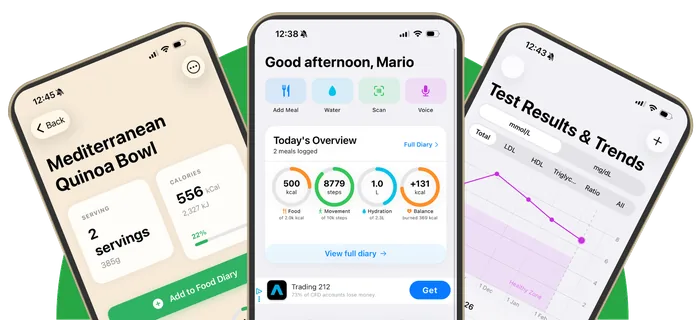
Log your meals and see your saturated fat and fibre against your goals, then add your test results to chart your LDL, HDL and triglycerides when you re-test.
- Barcode scanner
- LDL & HDL trends
- Voice meal logging