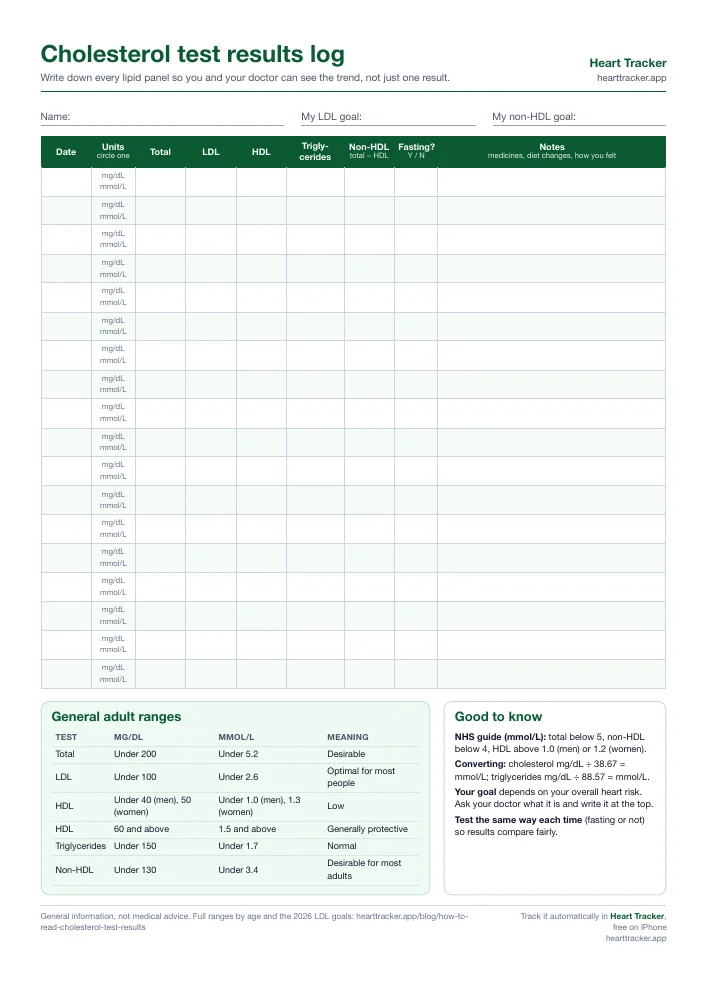
A one-page table for writing down every cholesterol test: date, units, total cholesterol, LDL, HDL, triglycerides, non-HDL, whether you fasted, and notes. Take it to appointments so you and your doctor can see the trend, not just the latest number.
General information, not medical advice
The reference ranges on the log are general adult ranges. Your own goals depend on your overall heart risk, so ask your doctor what they are and write them at the top of the page.
What's on the log
- A results table with 18 rows on A4 and 15 on US Letter: date, units (circle mg/dL or mmol/L), total, LDL, HDL, triglycerides, non-HDL, fasting (Y/N) and notes for medicines, diet changes or anything else that might affect a result.
- Spaces for your goals: your LDL and non-HDL goals, once your doctor has set them.
- A reference box with the general adult ranges in mg/dL and mmol/L, the NHS guide, and the factors for converting between units. They match our guide to how to read your cholesterol test results.
Tips for a useful log
- Copy every number in the same units. If one lab reports mg/dL and another mmol/L, use the cholesterol unit converter so the rows compare fairly.
- Work out non-HDL if it's missing. It's total cholesterol minus HDL. Many guidelines treat it as just as useful as LDL.
- Note whether you fasted. Eating mainly raises triglycerides and a calculated LDL, so test the same way each time where you can.
- Write down what changed. A new medicine, a diet change, weight loss or a recent illness can all move a result.
- Look for the trend. A single borderline number is usually re-checked rather than acted on alone. Three or four tests side by side tell you far more.
Not sure what a number means? Enter it in the cholesterol results explainer for a plain-English reading.
Sources
- MedlinePlus: Cholesterol levels, what you need to know
- NHS: Cholesterol levels
- Blumenthal RS, et al. 2026 ACC/AHA Guideline on the Management of Dyslipidemia. JACC. 2026
Frequently asked questions
What should I write in a cholesterol log?
For each test, write the date, the units (mg/dL or mmol/L), your total cholesterol, LDL, HDL, triglycerides and non-HDL, whether you fasted, and notes such as medicine changes, diet changes or recent illness. Non-HDL is total cholesterol minus HDL if your report doesn't show it.
How often should I get my cholesterol checked?
The 2026 ACC/AHA guideline recommends a lipid panel from age 19 and at least every 5 years after that, more often if you have other risk factors. People with high cholesterol, heart disease, diabetes, or who have just started treatment are checked more often, commonly within 4 to 12 weeks of a change and then every 3 to 12 months.
Why keep a record of my cholesterol results?
Cholesterol numbers vary from test to test, so one result can mislead. Seeing several tests side by side, with dates and notes, makes it much easier for you and your doctor to tell a real trend from normal variation, and to see whether a diet change or medicine is working.
Does the log work for mmol/L results?
Yes. Each row has a units column to circle, and the reference box shows the general ranges in both mg/dL and mmol/L, plus the NHS guide for mmol/L results.
Track it automatically in Heart Tracker
Prefer not to copy numbers by hand? Heart Tracker logs every lipid panel in mg/dL or mmol/L, charts your LDL, HDL, non-HDL and triglycerides over time, and lines them up with what you were eating between tests. Free on iPhone, no account needed.
Download Heart Tracker Free