The carnivore diet (meat, fish, eggs and sometimes dairy, with no plant foods) has no long-term trials, so nobody knows its effect on heart disease. What we do know is how its ingredients affect LDL: saturated fat raises it, and the diet removes fibre, beans, nuts and other foods that lower it. Many people on it see their LDL rise, sometimes sharply.
The short version
Likely effects: higher saturated fat and cholesterol intake, no soluble fibre, no plant sterols. Results vary: some people see little change, others see LDL double. If you try it: get a lipid panel (with apoB) before and 6 to 12 weeks after, and ask your doctor about Lp(a). Safer high-protein route: fish, poultry, eggs and lean cuts, with beans, oats and vegetables.
Why LDL often goes up
- Saturated fat: the biggest dietary driver of LDL. Fatty cuts, butter, cream and cheese can push intake far above the AHA target of about 13 g a day.
- No soluble fibre: fibre from oats, beans and fruit binds cholesterol in the gut. Without it you lose one of the most reliable diet effects.
- No plant protein, nuts or sterols: these each lower LDL a bit. The 2026 ACC/AHA guideline estimates plant protein instead of meat at about 0.20 mmol/L and a daily serving of nuts at about 0.12 mmol/L.
- Individual response: some people are hyper-responders whose LDL climbs steeply on low-carb, high-fat diets, often those who are lean. See hyper-responders and genetics.
Some followers argue that high LDL on a low-carb diet isn't a risk if triglycerides are low and HDL is high. That is an unproven hypothesis. LDL particles (measured as apoB) are causally linked to atherosclerosis, and no trial has shown that high LDL from a carnivore diet is safe.
What meat and eggs contribute
| Food | Serving | Saturated fat | Cholesterol | kcal |
|---|---|---|---|---|
| Beef rib roast, lean and fat | 3 oz (85 g) | 10 g | 71 mg | 305 |
| Beef burger, 80% lean, broiled | 3 oz (85 g) | 5.7 g | 75 mg | 230 |
| Beef burger, 95% lean, broiled | 3 oz (85 g) | 2.5 g | 75 mg | 148 |
| Bacon, baked | 3 slices (24 g) | 3.4 g | 26 mg | 132 |
| Egg, hard-boiled | 1 large (50 g) | 1.6 g | 187 mg | 78 |
| Butter | 1 tbsp (14 g) | 7.2 g | 30 mg | 100 |
| Salmon, Atlantic farmed, cooked | 3 oz (85 g) | 2 g | 54 mg | 175 |
| Chicken breast, roasted, no skin | 3 oz (85 g) | 0.9 g | 72 mg | 140 |
Compare the rib roast with the 95% lean burger and chicken breast: the choice of cut changes saturated fat several-fold. Dietary cholesterol (eggs, offal) matters less than saturated fat for most people, but hyper-responders may be sensitive to both. See red meat and eggs.
Tests worth getting
- Full lipid panel (total, LDL, HDL, non-HDL, triglycerides) before you start and after 6 to 12 weeks.
- apoB if available: it counts atherogenic particles and is a better gauge than LDL on low-carb diets.
- Lipoprotein(a) once in your life. It is inherited and diet doesn't change it. See our Lp(a) guide.
- Coronary artery calcium score if you are over about 40 and your doctor thinks it will change decisions.
If your LDL rises sharply, or you have a family history of early heart disease, talk to your doctor before continuing.
A lower-risk high-protein approach
- Build around fish, poultry, eggs and lean cuts rather than fatty beef, sausage and bacon.
- Add the foods that lower LDL: oats, beans, lentils, nuts and vegetables. Even a small amount of oat or bean fibre helps. See the Portfolio Diet.
- Keep dairy to lower-fat options and choose olive oil instead of butter for cooking.
- Test, change, re-test. A food tracker such as Heart Tracker shows saturated fat and fibre each day, so you can link changes to your results.
See protein trends and cholesterol for more on high-protein eating.
This is general information, not medical advice. If you take cholesterol medication or have a heart condition, check changes to your diet with your doctor, dietitian or pharmacist.
Sources
- Blumenthal RS, Morris PB, et al. 2026 ACC/AHA Guideline on the Management of Dyslipidemia. J Am Coll Cardiol. 2026;87(19). Sections 4.1.2–4.1.3.
- American Heart Association: Saturated fat (aim for under 6% of calories, about 13 g on 2,000 calories).
- Carson JAS, et al. Dietary cholesterol and cardiovascular risk: a science advisory from the American Heart Association. Circulation. 2020;141:e39–e53.
- Ference BA, et al. Low-density lipoproteins cause atherosclerotic cardiovascular disease. Eur Heart J. 2017;38:2459–2472.
- USDA FoodData Central (SR Legacy), values per serving calculated from the per-100 g record: FDC 168689, 171797, 171791, 167914, 173424, 173410, 175168, 171477. fdc.nal.usda.gov
Frequently asked questions
Does the carnivore diet raise cholesterol?
It often raises LDL, because it is typically high in saturated fat and contains no fibre, nuts, beans or other LDL-lowering foods. Response varies a lot between people, and there are no long-term trials of its effect on heart disease.
Is high LDL on a keto or carnivore diet dangerous?
LDL particles are a cause of atherosclerosis, and there is no trial evidence that high LDL is safe on a low-carb diet, even if triglycerides are low and HDL is high. If your LDL rises sharply, talk to your doctor and consider apoB and Lp(a) testing.
What is a lean mass hyper-responder?
A term used for lean, active people whose LDL rises very high on low-carb, high-fat diets. Whether this carries a heart risk is debated and is being studied. Treat very high LDL seriously and discuss it with your doctor.
How can I lower cholesterol on a high-protein diet?
Choose lean meat, fish and poultry, use olive oil rather than butter, and add oats, beans, nuts and vegetables. Re-test after about 3 months.
Do eggs raise cholesterol on a carnivore diet?
For most people, dietary cholesterol has a smaller effect than saturated fat. Some people are more sensitive. An egg has about 1.6 g of saturated fat and 187 mg of cholesterol, so the bigger issue is usually the fatty meat and butter eaten with them.
Track the diet and the results together
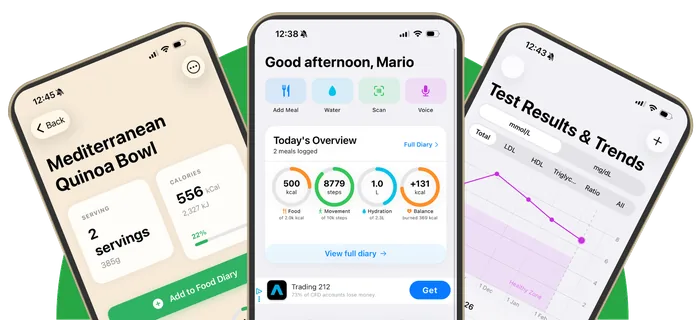
Log your meals in Heart Tracker to see saturated fat and fibre, then add each blood test to chart LDL, HDL and triglycerides against what you were eating.
- Barcode scanner
- LDL & HDL trends
- Voice meal logging