A vegan month can lower your cholesterol, but only if you build it around the right foods. Plant foods contain no dietary cholesterol and are rich in fibre, and vegetarian diets lower LDL in trials. But vegan cheese, pastries and coconut-oil products can carry as much saturated fat as the dairy they replace.
The short version
What the evidence says: a meta-analysis of 11 trials found vegetarian diets lowered LDL by about 0.34 mmol/L (13 mg/dL) compared with omnivorous diets. The traps: coconut oil is about 80% saturated fat, and many vegan cheeses, pastries and "butters" are made from it. The wins: beans, lentils, oats, tofu, nuts and vegetables.
What the research shows
A 2015 meta-analysis in the Journal of the American Heart Association pooled 11 trials of vegetarian diets and found they lowered total cholesterol, LDL and HDL compared with non-vegetarian diets, with LDL falling by about 0.34 mmol/L. The effect comes from eating less saturated fat and more fibre, soy protein and nuts, rather than from the lack of animal products itself. The 2026 ACC/AHA guideline likewise highlights that replacing meat with plant protein and eating nuts and soluble fibre lowers LDL.
That means a vegan diet built on junk food can be as bad for your lipids as a meat-eating one. What matters is what you eat.
Vegan foods that carry saturated fat
| Food | Serving | Saturated fat | Cholesterol | kcal |
|---|---|---|---|---|
| Coconut oil | 1 tbsp (14 g) | 11.5 g | 0 mg | 125 |
| Olive oil | 1 tbsp (14 g) | 1.9 g | 0 mg | 124 |
| Rapeseed (canola) oil | 1 tbsp (14 g) | 1 g | 0 mg | 124 |
| Meatless bacon | 1 oz cooked (16 g) | 0.7 g | 0 mg | 49 |
| Meatless frankfurter | 1 frankfurter (70 g) | 1.2 g | 0 mg | 163 |
| Walnuts | 1 oz (28 g) | 1.7 g | 0 mg | 183 |
Coconut oil is the big one. A tablespoon of coconut oil has more saturated fat than a tablespoon of butter and is the base of many vegan cheeses, chocolate, ice creams and baked goods. Check labels for "coconut oil" and "palm oil" and choose products with under 1.5 g of saturates per 100 g (the NHS "low" threshold). Nuts, even when high in total fat, are mostly unsaturated.
A cholesterol-friendly vegan month
| Food | Serving | Saturated fat | Cholesterol | kcal |
|---|---|---|---|---|
| Soya milk, original | 1 cup (243 g) | 0.5 g | 0 mg | 131 |
| Tofu, firm | ½ cup (126 g) | 1.6 g | 0 mg | 181 |
| Edamame, cooked | 1 cup (155 g) | 1 g | 0 mg | 188 |
| Lentils, boiled | ½ cup (99 g) | 0.1 g | 0 mg | 115 |
| Kidney beans, boiled | ½ cup (89 g) | 0.1 g | 0 mg | 113 |
| Oats, rolled | 40 g | 0.4 g | 0 mg | 152 |
- Breakfast: porridge with soya or oat milk, berries and a spoon of nut butter.
- Lunch: lentil soup, bean salad, or a hummus and veg wrap on wholemeal bread.
- Dinner: tofu stir-fry, chickpea and spinach curry, or bean chilli, using olive or rapeseed oil.
- Snacks: nuts, fruit, roasted chickpeas, edamame.
- Cooking fats: olive or rapeseed oil rather than coconut oil.
See the Portfolio Diet, which is plant-based by design and lowered LDL by about 13 to 17% in trials.
Things to watch
- Vitamin B12: only found reliably in animal foods and fortified products, so vegans need a supplement or fortified foods. It isn't a cholesterol issue but is important.
- Ultra-processed vegan foods: burgers, nuggets and ready meals can be high in salt and saturated fat. Compare labels.
- HDL may fall slightly on plant-based diets, as it did in the meta-analysis. That reflects a lower-fat diet and isn't a reason to worry in itself.
- Talk to your doctor or a dietitian before major dietary changes if you take medication or have other health conditions.
This is general information, not medical advice. If you take cholesterol medication or have a heart condition, check changes to your diet with your doctor, dietitian or pharmacist.
Sources
- Wang F, et al. Effects of vegetarian diets on blood lipids: a systematic review and meta-analysis of randomized controlled trials. J Am Heart Assoc. 2015;4:e002408.
- Blumenthal RS, Morris PB, et al. 2026 ACC/AHA Guideline on the Management of Dyslipidemia. J Am Coll Cardiol. 2026;87(19). Sections 4.1.2–4.1.3.
- Neelakantan N, et al. The effect of coconut oil consumption on cardiovascular risk factors: a systematic review and meta-analysis of clinical trials. Circulation. 2020;141:803–814.
- NHS: Fat, the facts (saturates: up to 30 g a day for men, 20 g for women).
- USDA FoodData Central (SR Legacy), values per serving calculated from the per-100 g record: FDC 171412, 171413, 172336, 172439, 169887, 170187, 172446, 172475, 168411, 172421, 173740, 173904. fdc.nal.usda.gov
Frequently asked questions
Does a vegan diet lower cholesterol?
On average, yes. A meta-analysis found vegetarian diets lowered LDL by about 0.34 mmol/L (13 mg/dL). The size of the effect depends on what you eat: beans, lentils, oats, nuts and tofu help, while coconut oil, vegan cheese and pastry can undo the benefit.
Is coconut oil OK on a vegan diet for cholesterol?
Coconut oil is about 80% saturated fat, more than butter, and a review of trials found it raised LDL compared with non-tropical vegetable oils. Olive, rapeseed and sunflower oils are better everyday choices.
Is vegan cheese better than dairy cheese for cholesterol?
Not necessarily. Many vegan cheeses are made from coconut oil and have as much saturated fat as dairy cheese. Cashew- or almond-based and low-saturate products are better; check the label.
How quickly can a vegan diet lower cholesterol?
LDL begins to respond within a few weeks. A one-month trial like Veganuary can show early changes, though a blood test after about 3 months of consistent eating gives the clearest result.
Do vegans have lower HDL?
HDL tends to be slightly lower on plant-based diets, which mainly reflects the lower fat intake. Total cholesterol, LDL and the ratio of total to HDL usually improve.
See what your vegan month adds up to
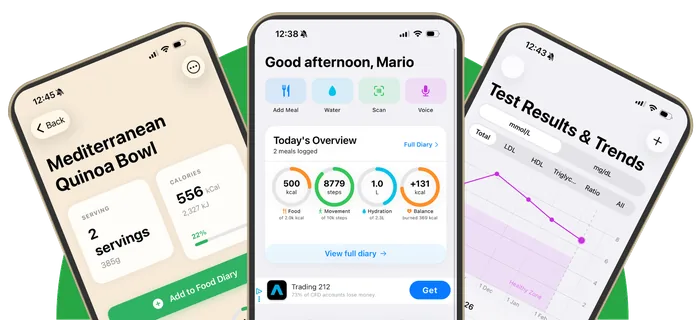
Log meals in Heart Tracker and see saturated fat, fibre and cholesterol per day. Barcode scanning helps you catch the hidden coconut oil.
- Barcode scanner
- LDL & HDL trends
- Voice meal logging