If it's a routine test and you can choose the date, don't choose the first week of January. If your doctor has asked for one, or you've just started treatment, go when you were told to. A slightly festive result is far more use to them than no result.
The short version
In a Danish study of 25,764 people, those tested in December and January had 15% higher total cholesterol and 20% higher LDL than those tested in May and June. For a routine check, about four weeks of normal eating after the holidays gives a fairer picture.
What the Christmas study found
Researchers in Copenhagen compared cholesterol results by the date people happened to be tested. Levels climbed from summer into December and January. Among people seen in the first week of January, 89% had total cholesterol above 5 mmol/L (193 mg/dL) and 77% had LDL above 3 mmol/L (116 mg/dL). After adjusting for other factors, their odds of high cholesterol were six times those of people tested during the rest of the year.
It's a striking number, and it needs a pinch of salt. The study compared different people at different times of year, so it can't prove the food did it. Cholesterol tends to run higher in winter anyway, and people move less and drink more around Christmas. The authors' advice was practical. Don't diagnose someone with high cholesterol on a Christmas test alone, and test again before starting treatment.
Does one big meal show up on a test?
Hardly. A study of more than 33,000 people looked at how lipids move in the hours after normal meals, and the biggest average changes were small.
| Measure | Largest average change after eating |
|---|---|
| Total cholesterol | Down 0.2 mmol/L (about 8 mg/dL) |
| LDL | Down 0.2 mmol/L (about 8 mg/dL) |
| HDL | Down 0.1 mmol/L (about 4 mg/dL) |
| Triglycerides | Up 0.3 mmol/L (about 27 mg/dL) |
Those are ordinary meals. A very large dinner with plenty of alcohol can push triglycerides up further, which is one reason not to book for the morning after. Most people don't need to fast, according to the NHS, but follow whatever instructions came with your appointment.
When to book
| Your situation | What makes sense |
|---|---|
| Routine check, nothing urgent | Late January or February, after about four weeks of normal eating |
| Follow-up on a new statin or dose change | The date you were given |
| Very high results before, or familial hypercholesterolaemia | The date you were given |
| Very high triglycerides | Do not delay, and ask your doctor about alcohol over the holidays |
| A free health check that only has January slots | Take it, and mention the holidays |
Chest pain or pressure, breathlessness, or pain spreading to your arm or jaw has nothing to do with test timing. Call 999 in the UK, 911 in the US or your local emergency number.
If January brings a bad number
- Don't panic, and don't ignore it. One result is a reading. Two or three are a trend.
- Write down what December was like. Illness, weight change, drinking and missed tablets all matter to whoever interprets it.
- Give it four to twelve weeks. That's long enough for diet changes to show up in LDL.
- Change the few things that count. Less butter, cheese, pastry and processed meat, and more oats, beans, lentils and nuts. Our 30-day plan lays it out.
- Book the retest now. A date in the diary does more than a resolution.
If you'd like help reading the result itself, put it into the free results explainer.
Keep December from getting away from you
The damage, if there is any, comes from the ordinary days in between. Enjoy Thanksgiving, Christmas Day and the party you actually care about. On the other days have your usual breakfast, get outside for a walk and make dinner something plain, like a turkey and barley soup. Keep taking any medication. Holidays are when tablets get forgotten.
This is general information, not medical advice. If you take cholesterol medication or have a heart condition, check changes to your diet with your doctor, dietitian or pharmacist.
Sources
- American Heart Association: Saturated fat (aim for under 6% of calories, about 13 g on 2,000 calories).
- NHS: Fat, the facts (saturates: up to 30 g a day for men, 20 g for women).
- Vedel-Krogh S, et al. The Christmas holidays are immediately followed by a period of hypercholesterolemia. Atherosclerosis. 2019;281:121–127.
- Langsted A, Freiberg JJ, Nordestgaard BG. Fasting and nonfasting lipid levels: influence of normal food intake. Circulation. 2008;118(20):2047–2056.
- NHS: High cholesterol, getting tested.
Frequently asked questions
How long after Christmas should I wait for a cholesterol test?
For a routine check, around four weeks of normal eating is a reasonable wait. If your doctor has asked for a test or is monitoring treatment, keep the appointment you were given.
Can one Thanksgiving dinner raise my cholesterol?
Not in a lasting way. LDL changes very little after a single meal. Triglycerides can rise for several hours, especially after a lot of food or alcohol.
Is cholesterol higher in winter?
On average, yes. Studies find cholesterol tends to be somewhat higher in colder months, and the holidays may add to that. It is one reason doctors look at more than one result.
Should I eat very healthily just before my test?
No. A few unusually strict days give a result that does not reflect how you normally live. Eat as you usually do and follow any fasting instructions you were given.
Have something to compare January with
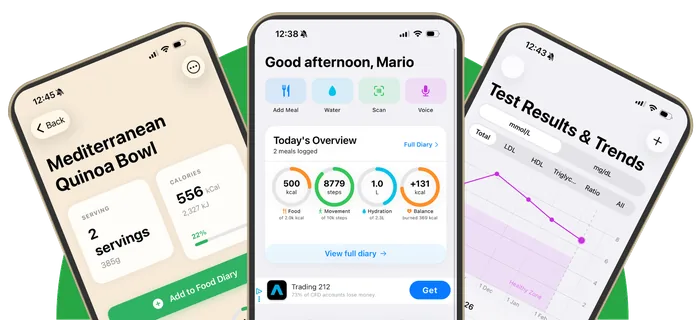
Add your last result to Heart Tracker today. When the next one comes it explains what changed, sets an LDL goal and counts down to your retest.
- 30-day LDL Reset
- Can I eat this? scanner
- LDL & HDL trends
On Android? Join the free beta.